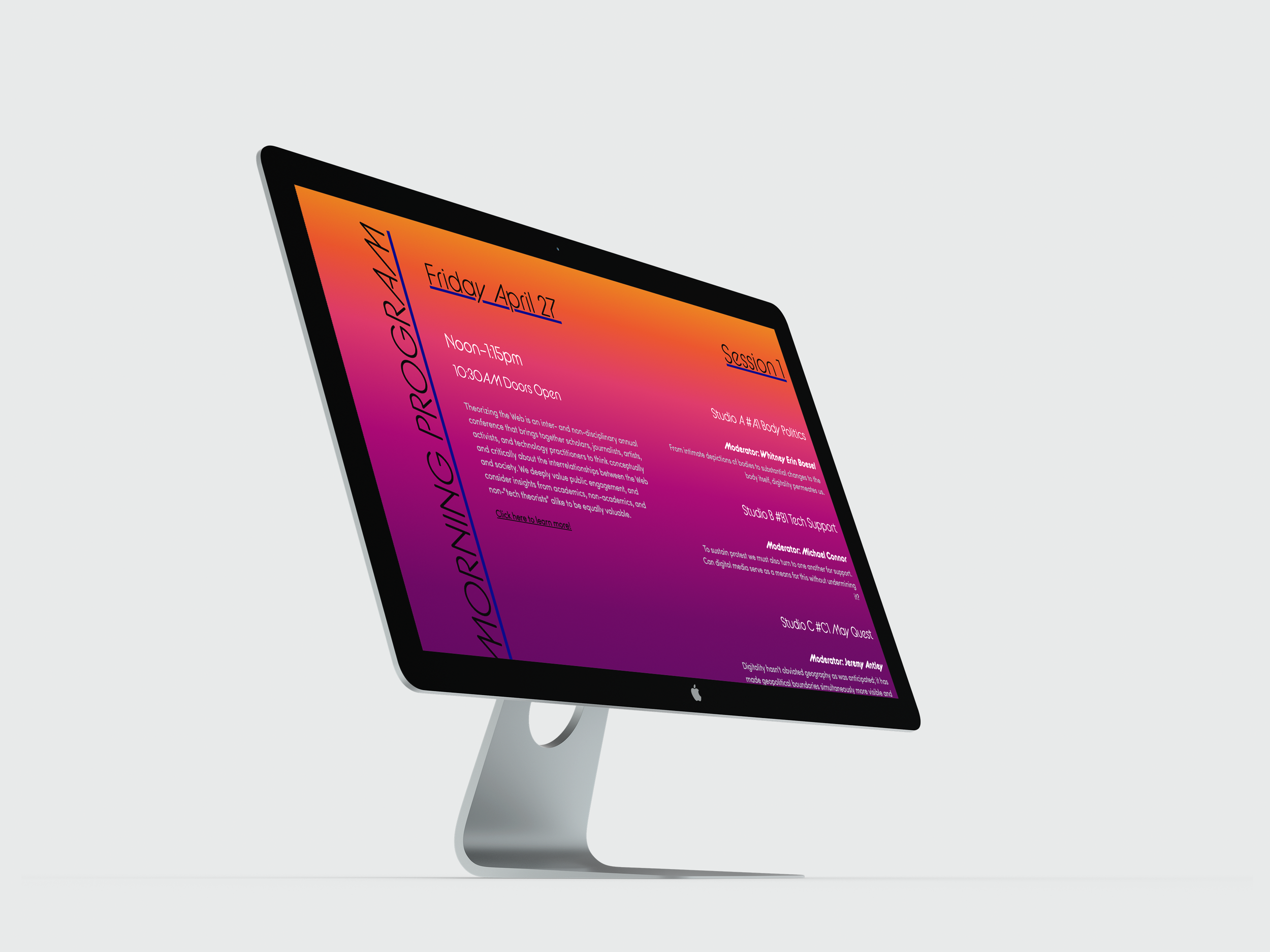
Theorizing The Web
A landing page/poster for an event.
RESPONSIBILITIES
Front-end design
UX Design
ROLE
UX Designer
Theorizing The Web
A landing page/poster for an event.
Team:
Solo
Role:
Front-end design, UX design, visual design, web design, content design
Software:
HTML, CSS, JS, Adobe XD
Duration:
1 week
Project Brief
Design and code a landing page for an announcement of an event.
Before creating the landing page, I designed a custom typeface in CSS for the poster. And then proceeded to create the landing page.
Research/ Context
Primary target users - people who are scholars, journalists, artists, activists, and technology practitioners to think conceptually and critically about the interrelationships between the web and society.
Goals
The goal was to portray the message in a manner that was visually appealing as well as easy to read and navigate.
Intrigue- draws the user in.
Answer these questions clearly:
what is the page for? what is the event about?
when is the event?
where does it take place?
why should I care?
clear hierarchy to separate content.


Landing Page
To reach the goals I posed at the beginning, I wanted to create a distinct hierarchy and organize the content clearly in the design.
Inspiration
I browsed through artwork and typographic posters for inspiration. The first thing that drew my eyes was an image with bright oranges and pinks- I was inspired by the retro 90’s era for the colour scheme which I thought would tie well with the content of the event.
Mood Board

Process

Initially, I was going to place all the content on one page - but as I grouped the content together, I realized it would be too crowded.
so I referred back to my goals and organized the content in a way that clearly answered the questions I posed at the beginning.
Intrigue- draws the user in.
Answer these questions clearly:
what is the page for? what is the event about?
when is the event?
where does it take place?
why should I care?
clear hierarchy to separate content.


The left vertical heading is an overarching heading framing the two respective pages, while the hierarchy within through text sizing and colour also creates additional grouping.
Finished product


Reflection
Overall, I learned an immense amount throughout this project. I found it rigorous due to the time frame but it was a fun challenge.
Coding the project gave me further perspective on how the design process works in tandem with the development. Having this knowledge gives me insight into the limitations and time constraints of working with code.
What would I do differently?
Due to time constraints, I didn't get a chance to conduct a lot of research. If I were to go back, I would do more user research.